
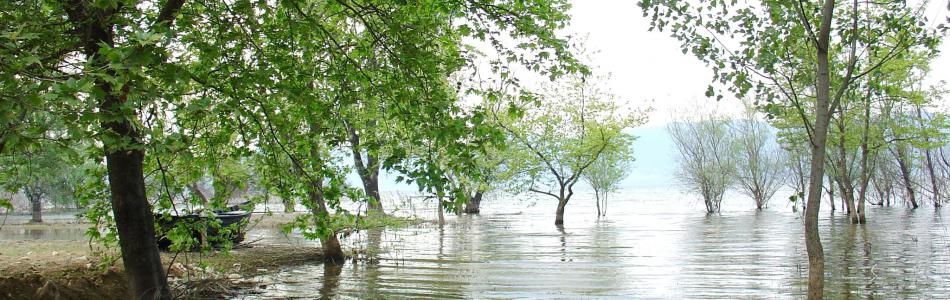
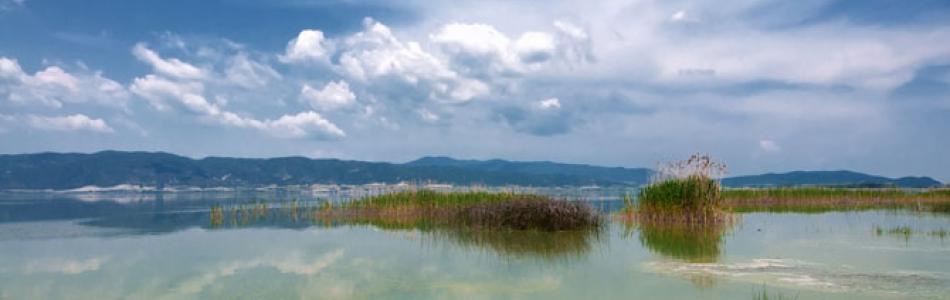
The lakes Koronia and Volvi are at a short distance from the city of Thessaloniki, just 12 and 39 kilometers respectively. This is a wetland of international importance, protected by the "Ramsar" convention (the Convention on Wetlands of International Importance as the Habitat for Aquatic Birds) which includes Koronia and Volvi lakes, the lakeside forest of Apollonia, the scenic forest of Rentina, the Monuments of Nature, and the plane trees of Scholari and Apollonia.
This is a rare ecosystem complex with riverine forests, reedbeds, wet meadows, mudflats, lakes, rivers, scrub and agricultural land. The current geomorphology was shaped 1.8 million years ago (lower Pleistocene) when cracks in the basin caused its immersion. Communication with the sea was stopped and a large lake was created. Corrosive and tectonic processes in Rendina valley channeled the waters of the lake into Strymon Gulf. The water that managed to stay in the lake was limited into to the deeper parts of the basin forming the two smaller lakes we see today.
Volvi is located 39 kilometers east of Thessaloniki. It has a maximum depth of 18 to 20 meters and it covers an area of about 65000 acres. Here you will find the endemic Liparia, Gelartza and Lakopsaro, fish species which do not live anywhere else in the world. Of course, there are other species such as the carp and the eel, whose population has declined because of a decrease in the water level of the lake. Also, here you can find the “kounoupopsaro”, the American fish species which was introduced to Greece in order to contribute to the biological control of mosquitos as it feeds on the larvae of these insects.
Today on the south shore of Volvi, there is still one of the last remaining lakeside forests of Europe: the lakeside forest of Apollonia -the Kingdom of the gray herons- which has enormous ecological value, since it is the only area in Greece that accommodates mixed colonies of gray herons and white stork. Moreover, this is the only place where you can find the unique combination of alder and poplar.